This is a piece of music I wrote for a short film that has just finished production. Watch it in my previous post, and read about my experience/challenges working on it.
Below is just the audio track. I named this piece Wrath of the Machine, because it is somewhat linked to the story. Curious? Watch it here!
Listen to this on Soundcloud.com
Some Stats:
Start-end dates: 1 Dec 2012 - 28 Mar 2013
DAW - FL Studio 10 / FL Studio 11
Virtual Instruments used:
- Kontakt Factory Library
- VSL special edition (strings/brass)
- Rhodes Premiere Acoustic Bass
- Pianoteq Piano
Tuesday, 18 June 2013

Monday, 17 June 2013
Short Film: Exit
Exit
Here's my soundtrack on an excellent short film that just wrapped up and got posted online. Music was written to the timing of the visuals.
My composition supplied music to the most part of their project, about 2/3 into the project. At the end during the credits roll, the team edited my piece back in again.
Exit from Rebel Banana on Vimeo.
This is my first track written to visuals. Project from start to finish was 1 Dec 2012 to 28 Mar 2013. During this time there were only 2 rounds of iteration.
For a version with just the music, read my next post here.
The team knew what they wanted, and Andrea, who liaised with me, was very concise in expressing what the team wanted, and the mood they were going for at each part of the story.
The music that the team envisioned was largely influenced by their liking for the music from Team Fortress 2, and even from The Incredibles by Disney.
I was quite apprehensive at the beginning, since this was a genre quite different from my usual style. However, the cinematic flavour that the music had to have was something I could rely on.
The visuals (storyboard/animatics) and their edited pacing were locked down very early in the production. This story has strong and definite moments. Using the cinematic feel as an anchor and some research into similar styles of music I managed to come up with the skeletal version of the structure.
This was just the second idea I set out to write.
In my first idea (which the team promptly rejected), I interpreted the mood as a lonely, with a tinge of eerie feel. However I had a flute part going in there that had a line with a thrill at the end. Somehow I liked it so much that I carried it over to my second idea, which ended up in the final version.
Thinking about the circumstances and the barriers that come up against good coordination and effective communication makes it even more surprising as to how smoothly the music production went.
First thing I would like to highlight, is the fact that, I have never met with any of the team members in person.
Second fact: to date, even after the production has ended, I have never had a voice conversation with any member of the team.
Third fact: The team and myself reside in different countries. They were studying and doing their production in Malaysia, while I am living in Singapore.
Now you can perhaps understand why I feel that it is a miracle that the music could be completed to their satisfaction without much hassle.
Our main communication tool was e-mail and messaging through Facebook. As I have mentioned before, Andrea is a very organised and responsible coordinator. She made sure I had references and instructions. As per our agreement, she did an overlay of textual instructions on their existing storyboard just for music. One thing I have to admire her for, is the fact that she used a generous amount of musical terms (Italian terms) in the instruction overlay. I have never told anybody this, but on my side I had to go and do a search on the meaning to many of those terms that she used :)
The smooth workflow that came about could also be partially due to my understanding of drama, storytelling and understanding of the idea and the team's angle in the story. As a visual effects artist that has worked on Hollywood films myself , I believe the understanding of that film language is paying off in that way.
There was a point in time where I was giving them a work-in-progress version that was still a way off from being finished, (it was half the length of the final soundtrack, but the main themes were already in place). Because of the instruments used and the fact that they thought what I showed them was the finished product, they were suggesting something very close to restarting from scratch.
I did something quite unconventional, to try and salvage the situation (and to aggressively sell my existing idea). Therefore, from all the visual effects breakdowns that I am used to doing, I gave them a walkthrough of the various parts of my arrangement played back against their visuals, mostly melodic tracks versus percussive tracks.
To my surprise and relief, they found that it was still on the right track. In the end I figured they liked the percussion track that gave the rhythmic drive to push the action along. In my mix (which was not yet balanced for all the instruments in the piece), my melodic instruments have overpowered the percussive, therefore the rhythmic driving probably wasn't there.
Finally, I have just been informed that this piece of video has been featured in the Staff Pick videos, recommended by Vimeo staff! It is very exciting, and I congratulate the team for the work well done!
If you enjoy it, do share your comments with the team on the Vimeo page! Also, you can visit their Facebook page here: facebook.com/exitRB.
Here's my soundtrack on an excellent short film that just wrapped up and got posted online. Music was written to the timing of the visuals.
My composition supplied music to the most part of their project, about 2/3 into the project. At the end during the credits roll, the team edited my piece back in again.
Exit from Rebel Banana on Vimeo.
This is my first track written to visuals. Project from start to finish was 1 Dec 2012 to 28 Mar 2013. During this time there were only 2 rounds of iteration.
For a version with just the music, read my next post here.
The team knew what they wanted, and Andrea, who liaised with me, was very concise in expressing what the team wanted, and the mood they were going for at each part of the story.
The music that the team envisioned was largely influenced by their liking for the music from Team Fortress 2, and even from The Incredibles by Disney.
I was quite apprehensive at the beginning, since this was a genre quite different from my usual style. However, the cinematic flavour that the music had to have was something I could rely on.
The visuals (storyboard/animatics) and their edited pacing were locked down very early in the production. This story has strong and definite moments. Using the cinematic feel as an anchor and some research into similar styles of music I managed to come up with the skeletal version of the structure.
This was just the second idea I set out to write.
In my first idea (which the team promptly rejected), I interpreted the mood as a lonely, with a tinge of eerie feel. However I had a flute part going in there that had a line with a thrill at the end. Somehow I liked it so much that I carried it over to my second idea, which ended up in the final version.
Thinking about the circumstances and the barriers that come up against good coordination and effective communication makes it even more surprising as to how smoothly the music production went.
First thing I would like to highlight, is the fact that, I have never met with any of the team members in person.
Second fact: to date, even after the production has ended, I have never had a voice conversation with any member of the team.
Third fact: The team and myself reside in different countries. They were studying and doing their production in Malaysia, while I am living in Singapore.
Now you can perhaps understand why I feel that it is a miracle that the music could be completed to their satisfaction without much hassle.
Our main communication tool was e-mail and messaging through Facebook. As I have mentioned before, Andrea is a very organised and responsible coordinator. She made sure I had references and instructions. As per our agreement, she did an overlay of textual instructions on their existing storyboard just for music. One thing I have to admire her for, is the fact that she used a generous amount of musical terms (Italian terms) in the instruction overlay. I have never told anybody this, but on my side I had to go and do a search on the meaning to many of those terms that she used :)
The smooth workflow that came about could also be partially due to my understanding of drama, storytelling and understanding of the idea and the team's angle in the story. As a visual effects artist that has worked on Hollywood films myself , I believe the understanding of that film language is paying off in that way.
There was a point in time where I was giving them a work-in-progress version that was still a way off from being finished, (it was half the length of the final soundtrack, but the main themes were already in place). Because of the instruments used and the fact that they thought what I showed them was the finished product, they were suggesting something very close to restarting from scratch.
I did something quite unconventional, to try and salvage the situation (and to aggressively sell my existing idea). Therefore, from all the visual effects breakdowns that I am used to doing, I gave them a walkthrough of the various parts of my arrangement played back against their visuals, mostly melodic tracks versus percussive tracks.
To my surprise and relief, they found that it was still on the right track. In the end I figured they liked the percussion track that gave the rhythmic drive to push the action along. In my mix (which was not yet balanced for all the instruments in the piece), my melodic instruments have overpowered the percussive, therefore the rhythmic driving probably wasn't there.
Finally, I have just been informed that this piece of video has been featured in the Staff Pick videos, recommended by Vimeo staff! It is very exciting, and I congratulate the team for the work well done!
If you enjoy it, do share your comments with the team on the Vimeo page! Also, you can visit their Facebook page here: facebook.com/exitRB.
Sunday, 9 June 2013
Against the Flow - Mma idea03 20130601 Trial01 010
Listen on SoundCloud.com
Here's a piece done for a martial arts school video as a speculative test. It has a driving feel with elements of sound design.
I hope you like the piece!
Start-End Dates: 20130601 - 20130606
DAW: FL Studio v11
VI libraries Used:
- heavyocity Damage
- NI Kontakt Factory Library
- SampleLogic cinematic guitars
- Image-Line Slayer
DSP plugins used
- NI solid bus comp
- NI RC24 (reverb)
- NI solid EQ
- NI EQ3 (inside Kontakt)
- VSL hybrid reverb
- izotope Ozone 5
Here's a piece done for a martial arts school video as a speculative test. It has a driving feel with elements of sound design.
I hope you like the piece!
Start-End Dates: 20130601 - 20130606
DAW: FL Studio v11
VI libraries Used:
- heavyocity Damage
- NI Kontakt Factory Library
- SampleLogic cinematic guitars
- Image-Line Slayer
DSP plugins used
- NI solid bus comp
- NI RC24 (reverb)
- NI solid EQ
- NI EQ3 (inside Kontakt)
- VSL hybrid reverb
- izotope Ozone 5
Monday, 13 May 2013
In The Heat of the Day
Listen on SoundCloud.com
Here's my latest work, my very first electronic piece. I did this at the request of a friend who requires a somewhat upbeat music to go with an instructional video on mixed-martial arts.
I realised I had to spend significantly more time on choosing sounds, and working on the sound design since it is a feature in the electronic music genre.
Here's hoping I can improve at creating electronic stuff because I hope to use sound design elements in conjunction with orchestral instruments in my future works.
I hope you like it!
Some stats on this piece:
Start-End Dates: 20130510 - 20130513 (3 days)
DAW: FL Studio 11
Synths in use:
- Image-Line Groove Machine Synth,
- Image-Line Autogun,
- Sonic Culture Konkrete,
- NI AbSynth 5,
- NI Kontakt Factory Library
Here's my latest work, my very first electronic piece. I did this at the request of a friend who requires a somewhat upbeat music to go with an instructional video on mixed-martial arts.
I realised I had to spend significantly more time on choosing sounds, and working on the sound design since it is a feature in the electronic music genre.
Here's hoping I can improve at creating electronic stuff because I hope to use sound design elements in conjunction with orchestral instruments in my future works.
I hope you like it!
Some stats on this piece:
Start-End Dates: 20130510 - 20130513 (3 days)
DAW: FL Studio 11
Synths in use:
- Image-Line Groove Machine Synth,
- Image-Line Autogun,
- Sonic Culture Konkrete,
- NI AbSynth 5,
- NI Kontakt Factory Library
John Williams Recording NBC Nightly News Beat
Amazing recorded footage of John William conducting his piece that gets played over NBC's nightly news.
It is so beautifully moving, the motif keeps evolving slowly, seamlessly moving from one form to the next. I can only describe this as wondrous. It lifted up my soul and left me with wet eyes as I listened and watched to the end.
Monday, 6 May 2013
The Making of Freljord Music
I happened to come across this great video, the making of the music behind Freljord. These guys really did a lot of work for the music score and were very serious about the recording process as well.
It is awesome that the music making folks were getting inspiration visually from the art and design department (and they even got that lady over to sing in their recordings). That should really be the way to go. Many productions tend to treat music either as a separate process from their visual workflow, or as an afterthought.
Also, I really like the fact that they were not rushing merely to meet a deadline, but they were actually allowing their creativity to soar while they explored different instruments that could further draw the player into the environment they create with the visuals, music and sound.
Touch and Go
Listen to this on SoundCloud.com
Some Stats to start off with:
Start date: 2013 May 5 (12.30 am)
End date: 2013 May 6 (4 am)
VI Library used: 100% Hammered Acoustic Guitar by Audio Wiesel (running off NI Kontakt)
DAW: FL Studio 11.0
Position & Reverb: VSL MIR-Pro 24
Dynamics: NI Solid Bus Comp, NI Solid EQ
Amp simulator / distortion processor: NI Guitar Rig 5
Yesterday I purchased Audio Wiesel's Hammered Acoustic Guitar (H.A.G.) virtual instrument.
 Hammered Acoustic Guitar (HAG) is a sampled virtual instrument that runs on Native Instrument's Kontakt. HAG requires the full version of Kontakt 5.0.3 or later.
The concept behind this sampled library is the use of drum sticks and brushes to produce musical tones and sound effects from an Ibanez AE acoustic guitar. In order to make it punchy and powerful the guys at AudioWiesel used two steel strings and tuned them to same pitch. This resulted in the strings modulating each other producing a very lively, natural and organic sounding tone.
Containing 45 patches, 2280 samples at 2.5GB in size, HAG is no child's play. Being sampled by high end audio recording equipment at 44.1kHz / 24-bit, HAG contains 9 times round-robin and 7 dynamic layers. HAG is broken down into 2 products (core, and fx & percussion). These can also be purchased as a bundle.
I was so caught up in the quality and potential of the library, I decided I could build a whole song out of just one library. So over the next 30 hours (and in between spending time with my wife and household chores), I managed to complete this piece using only sounds from H.A.G. Only 4 patches out of 45 in the HAG library were used,
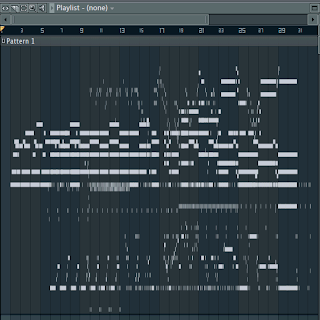 This was the first time I wasexploring the use of non-conventional sounds and using them to replace roles of a traditional band (using some patches to assume the bass, and some other sounds to fill up the high registers, for example). Same thing went for the percussive section.
Doing this made me become very aware of the sound I was producing, on top of the pitch and notes they were representing. Now I had to take care of another aspect of the production: controlling the tone and timbre of each part. This was on top of just making it play the correct pitch in the melodic and dynamic expressions department.
All this resulted in me spending quite a bit more time on the sound sculpting to get each track to sound just right. That was mainly due to the fact that I was only using 4 patches for the whole piece, so naturally I have more than 1 part using the same patch. If I did not make the same patches sound different for different parts, the whole mix would sound like a mess, with the same instrument playing all the different parts.
Fortunately HAG was programmed with sound-design in mind, so there were some controls that were conveniently located to enable me to drastically affect the sounds of each patch. However, I still needed to use Native Instrument's audio processing tools on top of those available in the patches themselves.
In the middle of writing I had a wild idea, and put a H.A.G. "soft mallet" patch through a guitar amp/distortion simulator. What I got was a pleasantly unique distortion sound that lends itself well to the piece. It is electric-guitar sounding, but because of the percussive nature of the soft mallet attack, it added interesting frequencies to the timbre as compared to what we are used to hearing on regular electric guitars.
Thanks to the faithful sampling workflow from the guys at AudioWiesel, who meticulously included the trailing end of all the notes, the 'electric guitar' actually had a long sustaining trail that gave a warm sustaining tone even after distortion is applied. Techniques like this give rise to the possibility of further expanding the sonic potential of this sampled virtual instrument.
For placement and reverb I used VSL's MIR24-Pro. Here's a peek into how the tracks were placed in 'space'.

Working on this made me quite happy about my working speed this time round. This piece felt easier as compared to my usual orchestral endeavours. It definitely has to do with the playability of the library patches, but I also feel it could be because this piece was set up more like a pop/rock arrangement, which has less parts to worry about, than an orchestra.
One of the unique points about the piece is that there are only two main chords: F Minor and B Major with accidental notes occasionally added to slightly alter the sound of the chords.
Finally, I entitled the piece Touch and Go, partly because this phrase was mentioned recently at work (by my boss), so it was at the front of my mind.
Also, I named it Touch and Go because I felt that it appropriately described my guilt for letting the song build up to the high point only briefly and then hastily declining in intensity for the rest of the way. To me the high point was near the middle when the distortion patch came in, and I felt I did not keep it long enough to satisfy the listener. From this point of view, I think I am justified to say that this piece is not really structurally pleasing.
I hope you like the piece!
Some Stats to start off with:
Start date: 2013 May 5 (12.30 am)
End date: 2013 May 6 (4 am)
VI Library used: 100% Hammered Acoustic Guitar by Audio Wiesel (running off NI Kontakt)
DAW: FL Studio 11.0
Position & Reverb: VSL MIR-Pro 24
Dynamics: NI Solid Bus Comp, NI Solid EQ
Amp simulator / distortion processor: NI Guitar Rig 5
Yesterday I purchased Audio Wiesel's Hammered Acoustic Guitar (H.A.G.) virtual instrument.

The concept behind this sampled library is the use of drum sticks and brushes to produce musical tones and sound effects from an Ibanez AE acoustic guitar. In order to make it punchy and powerful the guys at AudioWiesel used two steel strings and tuned them to same pitch. This resulted in the strings modulating each other producing a very lively, natural and organic sounding tone.
Containing 45 patches, 2280 samples at 2.5GB in size, HAG is no child's play. Being sampled by high end audio recording equipment at 44.1kHz / 24-bit, HAG contains 9 times round-robin and 7 dynamic layers. HAG is broken down into 2 products (core, and fx & percussion). These can also be purchased as a bundle.
I was so caught up in the quality and potential of the library, I decided I could build a whole song out of just one library. So over the next 30 hours (and in between spending time with my wife and household chores), I managed to complete this piece using only sounds from H.A.G. Only 4 patches out of 45 in the HAG library were used,

Doing this made me become very aware of the sound I was producing, on top of the pitch and notes they were representing. Now I had to take care of another aspect of the production: controlling the tone and timbre of each part. This was on top of just making it play the correct pitch in the melodic and dynamic expressions department.
All this resulted in me spending quite a bit more time on the sound sculpting to get each track to sound just right. That was mainly due to the fact that I was only using 4 patches for the whole piece, so naturally I have more than 1 part using the same patch. If I did not make the same patches sound different for different parts, the whole mix would sound like a mess, with the same instrument playing all the different parts.
Fortunately HAG was programmed with sound-design in mind, so there were some controls that were conveniently located to enable me to drastically affect the sounds of each patch. However, I still needed to use Native Instrument's audio processing tools on top of those available in the patches themselves.
In the middle of writing I had a wild idea, and put a H.A.G. "soft mallet" patch through a guitar amp/distortion simulator. What I got was a pleasantly unique distortion sound that lends itself well to the piece. It is electric-guitar sounding, but because of the percussive nature of the soft mallet attack, it added interesting frequencies to the timbre as compared to what we are used to hearing on regular electric guitars.
Thanks to the faithful sampling workflow from the guys at AudioWiesel, who meticulously included the trailing end of all the notes, the 'electric guitar' actually had a long sustaining trail that gave a warm sustaining tone even after distortion is applied. Techniques like this give rise to the possibility of further expanding the sonic potential of this sampled virtual instrument.
For placement and reverb I used VSL's MIR24-Pro. Here's a peek into how the tracks were placed in 'space'.

 |
| from the naming of the instruments you can probably figure out which HAG patches I used in the song |
One of the unique points about the piece is that there are only two main chords: F Minor and B Major with accidental notes occasionally added to slightly alter the sound of the chords.
Finally, I entitled the piece Touch and Go, partly because this phrase was mentioned recently at work (by my boss), so it was at the front of my mind.
Also, I named it Touch and Go because I felt that it appropriately described my guilt for letting the song build up to the high point only briefly and then hastily declining in intensity for the rest of the way. To me the high point was near the middle when the distortion patch came in, and I felt I did not keep it long enough to satisfy the listener. From this point of view, I think I am justified to say that this piece is not really structurally pleasing.
I hope you like the piece!
Subscribe to:
Posts (Atom)